
For educational purposes only. Not medical or legal advice. Consult a qualified medical practitioner. Medical cannabis is available only in accordance with Mississippi law. Cannabis remains illegal under federal law. Keep away from children.
Sativa:
Offers an uplifting, stimulating, energy-increasing high.
Indica:
Offers a deep physical, pain-relieving, sedating high.
Hybrids:
Can offer uplifting mental stimulation and physical relaxation.
When should I use it?
Sativa:
Daytime usage.
Indica:
Nighttime usage.
Hybrids:
Anytime usage.
What do they look like?
Sativa:
Tall, slender plants with narrow, lighter leaves.
Indica:
Short, bushy plants with broad, dark leaves.
Hybrid:
Because genetics are mixed, hybrids do not have a definitive look and can range from short and bushy to tall and slender depending on which traits are dominant.
What would work best for me?
Sativa:
May help with conditions such as:
Indica:
May help with:
Hybrid:
Hybrid strains can help with all the conditions listed above depending on whether the strain is indica- or sativa-dominant.
The operations of the endocannabinoid system can be broken down into three components:
Endocannabinoids
Molecules naturally produced by your body that are structurally similar to plant cannabinoids.
Receptors
Proteins found on the surfaces of cells throughout the body that endocannabinoids bind to.
CB1 Receptors:
Located mostly in the central nervous system (brain and spinal cord), which regulate mood, memory, pain, and motor control.
CB2 Receptors:
Located mostly in the peripheral nervous system, particularly on immune cells, which help regulate inflammation and immune responses.
Metabolic Enzymes
Specialized proteins that destroy endocannabinoids once they have completed their function, preventing over-signaling.
Retrograde Signaling
Unlike most neurotransmitters that travel from the sending neuron to the receiving neuron, endocannabinoids work in reverse — a process called retrograde signaling.
How does cannabis affect the endocannabinoid system?
Cannabis contains compounds known as phytocannabinoids (plant cannabinoids). These molecules resemble the endogenous cannabinoid molecules the body naturally produces.
When these compounds enter the body, they interact with cannabinoid receptors in the ECS. The two primary receptors scientists have identified are CB1 and CB2.
THC binds strongly to CB1 receptors, while CBD interacts indirectly with the ECS signaling by affecting receptor activity and enzyme breakdown.
Plant cannabinoid effects may vary depending on dosage.
Understanding product labels and Certificates of Analysis (COAs) can help you make informed decisions about the products you choose. Here’s a simple guide to what these terms mean and how to read them.
Cannabis products often use the metric system to describe weight, volume, and potency.
Potency is typically listed in milligrams (mg) or as a percentage (%).
Examples:
Always check whether the amount listed refers to the entire package or a single serving.
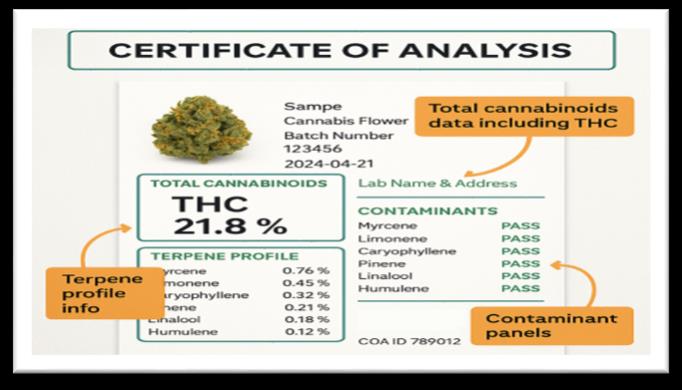
A Certificate of Analysis, or COA, is a laboratory report that verifies a product has been tested for potency, safety, and quality. COAs are generated by independent testing laboratories and provide transparency about what’s in a product.
Product Information — verify that the following matches your product:
Cannabinoid Profile — the concentration of cannabinoids found in the product, such as:
Results may be listed as a percentage (%) or in milligrams (mg).
Terpene Profile — aromatic compounds that contribute to a product’s scent and flavor. Common terpenes include:
Safety Testing — COAs typically include testing for:
Products that meet regulatory requirements will be marked as Pass for these categories.
| Term | Meaning |
|---|---|
| ND | Not Detected |
| PASS | Meets testing requirements |
| FAIL | Does not meet requirements |
| LOQ | Limit of Quantification |
| LOD | Limit of Detection |
COAs provide an independent verification of a product’s contents and safety. By reviewing a COA, consumers can confirm:
Taking a few moments to review a product label and COA can help you better understand exactly what you’re purchasing and consuming.
EXAMPLE
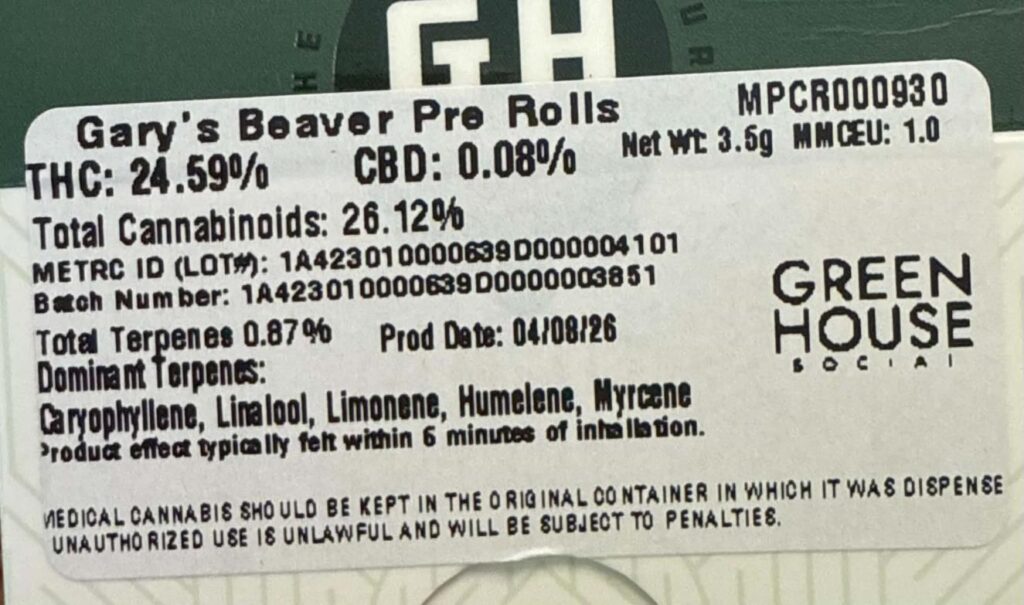
Strain/Product Name: Gary’s Beaver Pre Rolls. This is the specific cultivar (strain) of cannabis used.
Net Wt: 3.5g: The total weight of the cannabis flower inside the package is 3.5 grams (typically a standard eighth of an ounce, likely split into multiple pre-rolls).
MPCR000930 / MMCEU: 1.0: These are regulatory tracking codes. “MMCEU” stands for Medical Mississippi Cannabis Equivalency Unit, indicating this equals 1 unit under state medical cannabis allotment limits.
Green House Social: This is the brand or dispensary branding associated with the product.
THC: 24.59%: This is the primary psychoactive compound. At nearly 25%, this is a relatively high-potency product.
CBD: 0.08%: Cannabidiol is a non-psychoactive cannabinoid known for relaxation. This is a very low percentage, meaning this strain is highly THC-dominant.
Total Cannabinoids: 26.12%: This includes the THC, CBD, and other minor cannabinoids (like CBG or CBN) present in the plant.
Terpenes are the essential oils that give cannabis its specific smell, taste, and nuanced effects (the “entourage effect”).
Total Terpenes: 0.87%: This is the total percentage of therapeutic aromatic compounds by weight.
Dominant Terpenes — listed in order of dominance:
Prod Date: 04/08/26: This was packaged/produced on April 8, 2026.
METRC ID (LOT#) & Batch Number: These long strings of numbers are for seed-to-sale tracking. If there is ever a product recall or quality issue, the state and the cultivator can trace exactly which batch it came from.
Product effect typically felt within 6 minutes of inhalation: Because smoking or vaping goes directly into the lungs and bloodstream, the onset is rapid compared to edibles (which can take 1–2 hours).
Legal Warning: The fine print at the bottom reminds you that it is a medical cannabis product, must be kept in its original container, and unauthorized use is illegal.
Terpenes are what make certain cannabis plants smell or taste different from others.
They may work with the plant’s cannabinoids and other compounds to produce effects such as anti-inflammatory or sedative effects and decreased appetite.
How do they work?
Terpenes naturally occur within plants to protect the plant from harsh weather or predators.
The main hypothesis surrounding terpenes in cannabis is that the plant’s terpene profile works in tandem with its cannabinoid content — including THC and CBD — to produce the effects people associate with different strains.
What terpenes should I look for and what are their effects?
There are 146 known terpenes within the cannabis plant, but experts have only linked a handful of them to specific effects.
You will likely see these terpenes in most medical cannabis products:
Myrcene
Found in mangoes, myrcene can have antifungal and antibacterial properties.
This terpene is associated with a relaxed or sleepy high and may amplify the psychoactive experience.
The rate at which THC and other cannabinoids enter the brain with myrcene may be greater than usual, potentially leading to a quicker onset of effects.
Limonene
One of the more common terpenes, limonene has distinct citrus notes and may have anti-anxiety properties.
It is most commonly found in citrus plants such as lemons.
This terpene is generally associated with a happy or uplifting high.
Caryophyllene
Mainly found in cloves, rosemary, and hops, caryophyllene may be useful for managing symptoms of anxiety and depression.
It is usually associated with a soothing, relaxed experience focused on pain relief.
Linalool
Found heavily in lavender, linalool is commonly associated with stress relief and sedative effects.
It is generally associated with a calming, stress-relieving experience and may be useful for people struggling with insomnia.
Humulene
This terpene is found in plants such as ginseng and hops.
It is commonly associated with decreased appetite and a balanced, mellow experience.
It may be useful for patients struggling with anxiety or diabetes.
Pinene
Pinene is associated with a focused and alert experience and may be useful for daytime use.
It is most commonly found in pine trees and provides a distinct pine smell and taste.
Phytocannabinoids:
These naturally occur in the Cannabis sativa plant.
Endocannabinoids:
Chemical compounds (such as anandamide) that your own body creates to maintain internal balance (homeostasis).
Synthetic Cannabinoids:
Laboratory-made chemicals designed to mimic the effects of phytocannabinoids.
How do they work?
Cannabinoids interact with receptors (mainly CB1 and CB2) located throughout your central nervous system and immune system.
When a cannabinoid binds to a receptor (like CB1 or CB2), it recreates the receptor’s shape, turning up or down various cell activities.
When this interaction happens with a phytocannabinoid, the cell activities are affected.
The operations of the endocannabinoid system can be broken down into three components:
Endocannabinoids
Molecules naturally produced by your body that are structurally similar to plant cannabinoids.
Receptors
Proteins found on the surfaces of cells throughout the body that endocannabinoids bind to.
CB1 Receptors:
Located mostly in the central nervous system (brain and spinal cord), which regulate mood, memory, pain, and motor control.
CB2 Receptors:
Located mostly in the peripheral nervous system, particularly on immune cells, which help regulate inflammation and immune responses.
Metabolic Enzymes
Specialized proteins that destroy endocannabinoids once they have completed their function, preventing over-signaling.
Retrograde Signaling
Unlike most neurotransmitters that travel from the sending neuron to the receiving neuron, endocannabinoids work in reverse — a process called retrograde signaling.
How does cannabis affect the endocannabinoid system?
Cannabis contains compounds known as phytocannabinoids (plant cannabinoids). These molecules resemble the endogenous cannabinoid molecules the body naturally produces.
When these compounds enter the body, they interact with cannabinoid receptors in the ECS. The two primary receptors scientists have identified are CB1 and CB2.
THC binds strongly to CB1 receptors, while CBD interacts indirectly with the ECS signaling by affecting receptor activity and enzyme breakdown.
Plant cannabinoid effects may vary depending on dosage.
We use cookies to improve your experience on our site. By using our site, you consent to cookies.
Manage your cookie preferences below:
Essential cookies enable basic functions and are necessary for the proper function of the website.
These cookies are used for managing login functionality on this website.